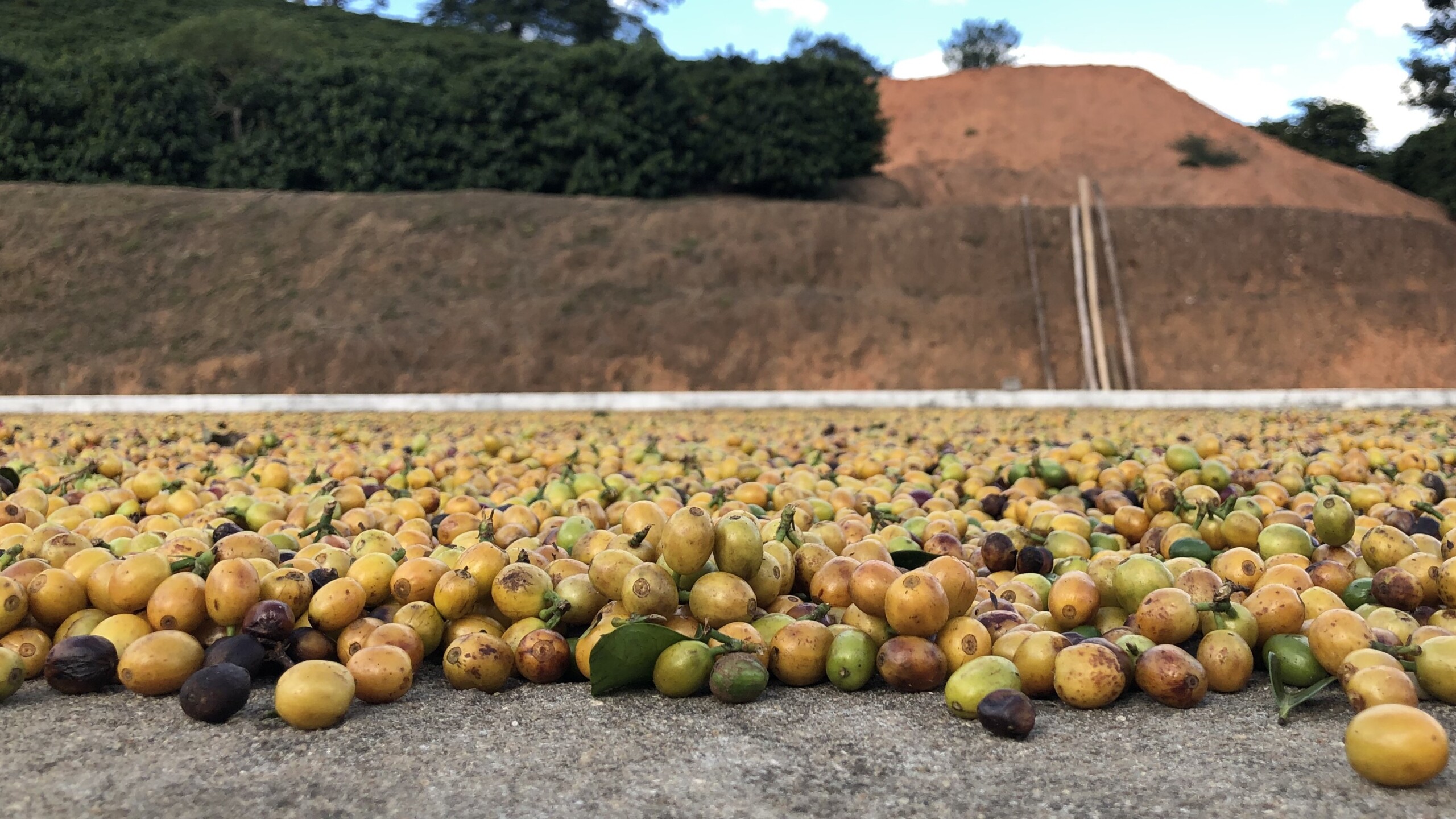
Bourbon. The name belongs to a French dynasty that ruled several nations across centuries and gave us both Versailles and the French Revolution. The dynasty named an island in the Indian Ocean, and that island would come to name a varietal, whose impact is just as widespread and as current. The tree is tall, green tipped, medium yielding and susceptible to a lot, but very good in the cup.
Most people know the varietal is named after the island now called Réunion. It’s located in the Indian ocean and is volcanic, green, and in a conveniently placed location for ships that travelled out of Arabia Felix, the region we call Yemen today. But the true story is not that simple, whilst also encapsulating behaviour that we still see in coffee today.
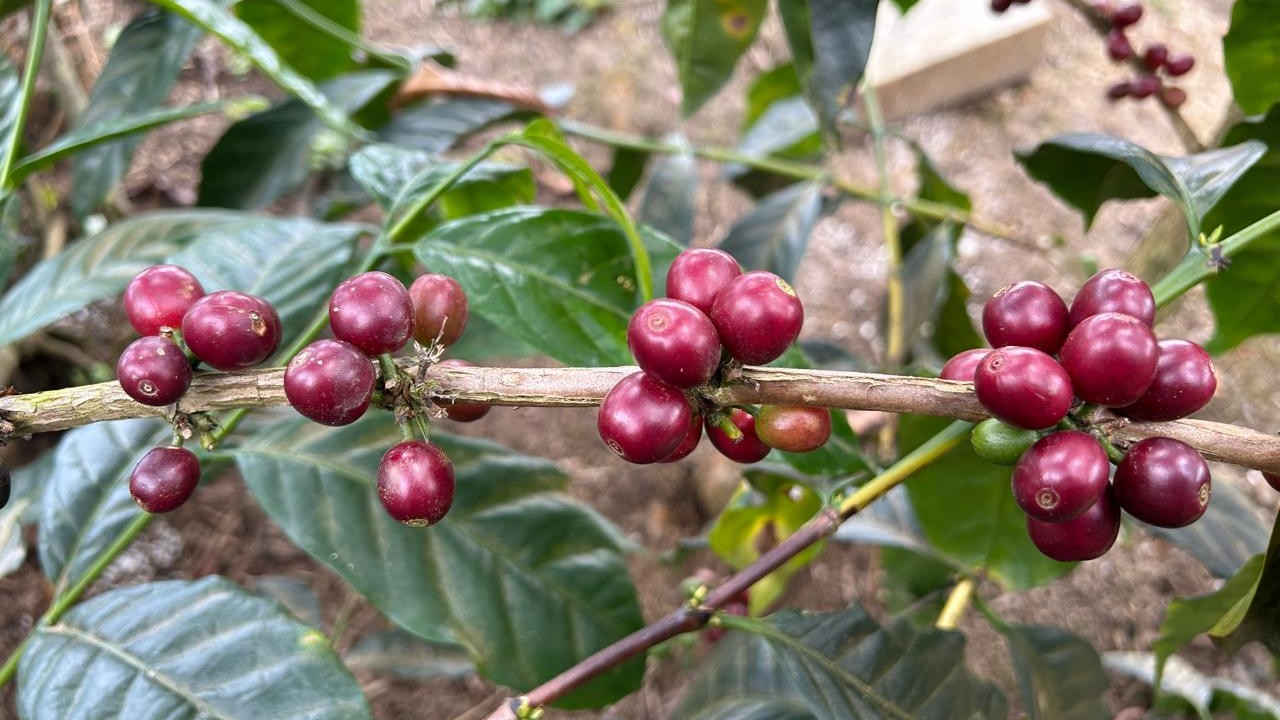 Bourbon cherries, Peru.
The Island Experiment
The island already had coffee when the French arrived with plants they had taken from Arabia Felix in the early 1700’s. Growing wild in the forests, Coffea mauritiana was a different species altogether, but was also proof that the island could grow coffee. It had a small commercial life, ultimately losing out in the cup to the material coming in from Yemen. By the 1800s its only credited remaining use was to bolster weak or damaged coffees.
The plants that came from Yemen had already been through the same genetic narrowing that produced Typica. Yemen is dry. Coffee grew in the mountains on terraces, and the water was diverted especially for it to grow. Réunion is one of the wettest places on earth. Volcanic, forested, steep; it experiences fifty centimetres on its leeward side, yet over ten metres of rain a year on the windward.
The accounts vary on how few plants survived the voyage and there were other, newer introductions but the plants that grew and were propagated were done so in relative isolation. It created a bottleneck. A bottleneck does not cause mutation, as the mutation carries on at whatever rate it always had, but what a tiny, self-pollinating population changes is what happens to a mutation once it occurs.
Arabica pollinates itself. In a plant that crosses freely, a new recessive sits hidden in a single copy paired with a working copy from an unrelated partner. It can travel that way for generations without anyone ever seeing it. Especially where the parent plant is a tree, and sustains a harvest for many years. But in Ile de Bourbon, the tree carrying the new mutation fertilises itself, and a quarter of its seed carries the fault in both copies. As it is propagated deliberately and quickly, the mutation is standing in the open in the very next generation, on the same slope, in the seedlings of the same tree.
There is no population to get lost in because the parent was already uniform at almost every other point. The visible seedling breeds true much quicker, especially when planting a business from a limited source, and that matters hugely. A variant that fails to breed true is a curiosity and a story. A variant that does breed true is a variety.
Becoming Bourbon
Here is where it gets awkward. If you look at what was actually growing on that island, you find multiple coffees, not one.
Welter, writing in 1868, lists some; Moka, Myrte, and Leroy, three varieties cultivated on Réunion, and that coffee is sold as a blend in variable proportions under the name café Bourbon. Coffee was known as the source it sailed from. The blend that was working in exactly the same way as the rest of the industry was and still does to this day.
There are discussions noting differences in the trees, and discussion on those discussions too. Then there is Laurina and Mauritiana referred to as café Bourbon too. So it’s not hard to see why there is so much confusion. The point is, we refer to things as where they are from, when we are not from there ourselves.
For example, in an 1834 Brazilian agricultural journal the printed phrase café Bourbon is the thing known in commerce by that name, and nobody meant a tree by it. This is relevant as in the late 1850s Brazil went looking for a replacement to the tiring Typica it had already planted. The industry was growing, and the story has an emissary sent out to the island to fetch seed. Bourbon had, deservedly, a great reputation, and so with all agreements received they travelled to the newly named Reunion for ‘Café Bourbon’.
Twenty-five years later a Dutch government inspector walked the Brazilian estates and wrote up what he found. For Bourbon he simply noted that many planters preferred it, with one estate carrying upwards of 500,000 trees of it. Other varieties had names, dates, and details attached, but the variety whose genetics everyone now wants had already become too ordinary to explain. That is the moment a variety starts to solidify.
In 1907 it is referred to as ‘Bourbon brésilien’, alongside National, Jaune ou de Botucatu, Maragogype, and Murta. Murta is a spelling of Myrte, and argues the evidence of the mixed seed export by its presence. What we can read is lines growing side by side, under one sky, in the hands of people who had a commercial reason to say which was which.
The botanical name as far as we can tell, was first published in El Salvador in 1928, credited to a Brazilian before that. Campinas fixed it officially in 1939, setting the reference against which everything since has been measured.
Bourbon, apart from being one of the most important varietals in coffee still, exemplifies the type of behaviour we still find. Geographic names applied to sometimes mean different things. Variations mutating or not, names bleeding across trees and stories being told or invented to suit.
Whatever version of whichever story you choose to pick, Bourbon had established its reputation for cup quality long before its own name. Perhaps that is why it is still chosen despite better options being out there for disease and pest resistance. Maybe this is why it gets appended to pink, or orange, striped or chilli for newer varietals discovered that also taste good, regardless of even if they end up being related to the tree or not. The name is something to be proud of.
As a considerable branch of a family where the opposite is called simply typical, it suits that it sits at the opposite end of that scale, and bearing the name of royalty.